
Microsoft stores data in glass slabs for 10,000-year archival
Summary
Microsoft's Project Silica stores data in glass using lasers, offering dense, 10,000-year, energy-free archival storage. Reading uses AI. Scalability for massive data remains a challenge.
Microsoft puts data into glass
Microsoft Research announced a functional storage system this Wednesday that etches digital data into small glass slabs. The team published its findings in the journal Nature, detailing a process that achieves a data density of over 1 Gigabit per cubic millimeter. This project, known as Project Silica, aims to solve the problem of long-term archival storage by using a medium that remains stable for thousands of years.
Current archival methods like magnetic tape or hard drives require constant maintenance and consume energy even when sitting idle. Microsoft’s glass slabs require zero energy to maintain data once the writing process is complete. The system uses borosilicate glass, a material chosen for its resistance to environmental factors that typically degrade digital media.
The researchers developed this system to handle the massive growth of global data that needs to be stored indefinitely. While hard drives might last five years and tape might last thirty, Microsoft claims its glass slabs can survive for 10,000 years. This longevity comes from the physical and chemical stability of the glass itself, which does not suffer from bit rot or magnetic interference.
Lasers write data into glass
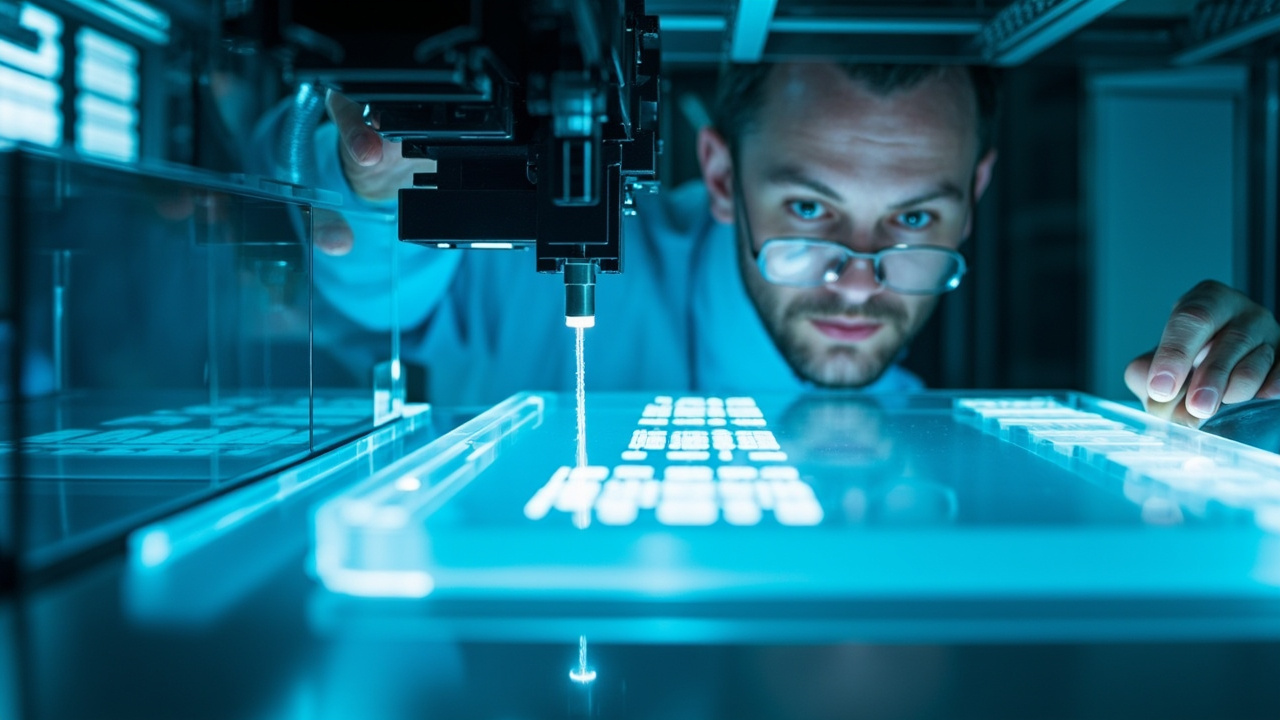
Microsoft uses femtosecond lasers to write data into the glass slabs. These lasers emit pulses that last only 10^-15 seconds, allowing the system to create microscopic changes in the material without heating the surrounding glass. The speed of these pulses enables the laser to focus energy on a precise point to create a "voxel," or a 3D pixel.
The writing process creates these voxels in layers throughout the thickness of the glass. The team developed hardware that uses four lasers simultaneously to increase the writing speed. This configuration allows the system to write data at a rate of 66 megabits per second. While this is slower than modern hard drives, it is designed for archival tasks where data is written once and rarely changed.
Microsoft tested two distinct methods for writing these voxels to determine which offered the best density and reliability. The first method relies on birefringence, where the laser changes how the glass refracts polarized light. This technique involves a two-step process where one pulse creates an oval-shaped void and a second polarized pulse sets the data state.
- Slab dimensions: 12 cm x 12 cm x 0.2 cm
- Maximum capacity: 4.84TB per slab
- Storage density: Over 1 Gigabit per cubic millimeter
- Estimated lifespan: 10,000 years at room temperature
- Current write speed: 66 megabits per second
Two methods for creating voxels
The birefringence method allows the system to store more than one bit in each voxel. Because the system can resolve multiple orientations of the oval-shaped voids, it increases the overall capacity of the slab. This high-density approach allows a single 12 cm slab to hold up to 4.84TB of data, though it requires high-quality glass and complex optical hardware.
Microsoft also developed a simpler alternative that varies the refractive index of the glass by changing the energy of the laser pulse. This method is more versatile because it works on almost any transparent material. However, it offers lower density, topping out at approximately 2TB for a slab of the same size.
Both methods utilize low-density parity-check codes for error correction. This is the same error-correction technology found in 5G networks. By combining neighboring bits into symbols, the system maximizes the multi-bit storage capabilities of each voxel. This ensures that the data remains readable even if minor physical imperfections exist in the glass.
Neural networks read the slabs
Reading data from the glass requires an automated microscope system. Microsoft uses phase contrast microscopy to detect the subtle changes in the refractive index of the voxels. The microscope moves its focus through the different layers of the glass, capturing images of the data at specific depths.
The system uses convolutional neural networks (CNNs) to interpret these microscope images. Reading data from 3D glass is difficult because voxels in nearby layers can create visual noise. The AI system analyzes images from the target layer and the surrounding planes to filter out this interference and accurately reconstruct the bitstream.
The etching process includes specialized symbols that act as positioning markers for the microscope. These markers allow the automated lens to find its place on the 12 cm slab with extreme precision. Once the microscope aligns itself, it moves through the stack of voxels, capturing the data required for the CNN to process.
It is a clever use of existing AI computer vision to solve a hardware limitation. Without the neural network, the microscope would struggle to distinguish between layers. The AI training allows the system to recognize the "fingerprint" of a voxel even when the image is slightly out of focus or obscured by the layers above it.
Glass survives for ten millennia
Microsoft subjected the glass slabs to accelerated aging experiments to test their durability. These tests involved exposing the glass to high temperatures, moisture, and electromagnetic interference. The results suggest that the data remains stable for over 10,000 years when stored at room temperature.
The borosilicate glass is physically and chemically resistant to most forms of environmental degradation. Unlike magnetic media, it cannot be wiped by a magnet or corrupted by a solar flare. It does not require the climate-controlled environments that are mandatory for modern data centers, which could significantly reduce the carbon footprint of long-term storage.
The material is also immune to moisture ingress, which is a common cause of failure for optical discs like CDs and DVDs. While the slabs still require careful handling to avoid physical shattering, they are far more durable than any existing digital medium. Microsoft views this as a permanent solution for "cold" data that must be kept for the duration of human civilization.
Massive data requirements limit adoption
Despite the technical success, the system faces significant scaling challenges. Writing a single 4.84TB slab currently takes over 150 hours. Microsoft engineers believe they can reduce this time by adding up to 12 additional lasers to the writing hardware, but the bottleneck remains significant for enterprise-level data needs.
The Square Kilometer Array telescope provides a clear example of the scale required. This project is expected to generate 700 petabytes of data every year. To store that data on Project Silica slabs, a facility would need 140,000 glass plates annually.
Keeping up with that volume of data would require more than 600 Silica machines operating in parallel. While the glass itself is inexpensive, the infrastructure to write and read it at that scale is currently theoretical. Microsoft will need to significantly increase the throughput of its laser systems before it can compete with traditional tape libraries.
The technology looks like science fiction, but the math for global scaling is still grounded in a difficult reality. Project Silica is a functional proof of concept, but it is not yet a replacement for the petabytes of storage used by cloud providers. For now, it remains a specialized tool for the most critical, long-term archival needs.
Related Articles
Microsoft's glass storage system preserves data for thousands of years
Microsoft researchers have developed a laser-based system that writes data into durable glass, creating a long-term storage solution that outlasts magnetic media.
Microsoft stores 2.02 TB of data on Pyrex glass for archival use
Microsoft's Project Silica stores data in common borosilicate glass (like Pyrex) using lasers for over 10,000 years. They achieved 2TB storage and faster writes, reducing equipment.
Stay in the loop
Get the best AI-curated news delivered to your inbox. No spam, unsubscribe anytime.