
Annular solar eclipse creates 'ring of fire' over Antarctica
Summary
A "ring of fire" annular solar eclipse occurred over Antarctica on Feb. 17, visible as a partial eclipse in some southern regions.
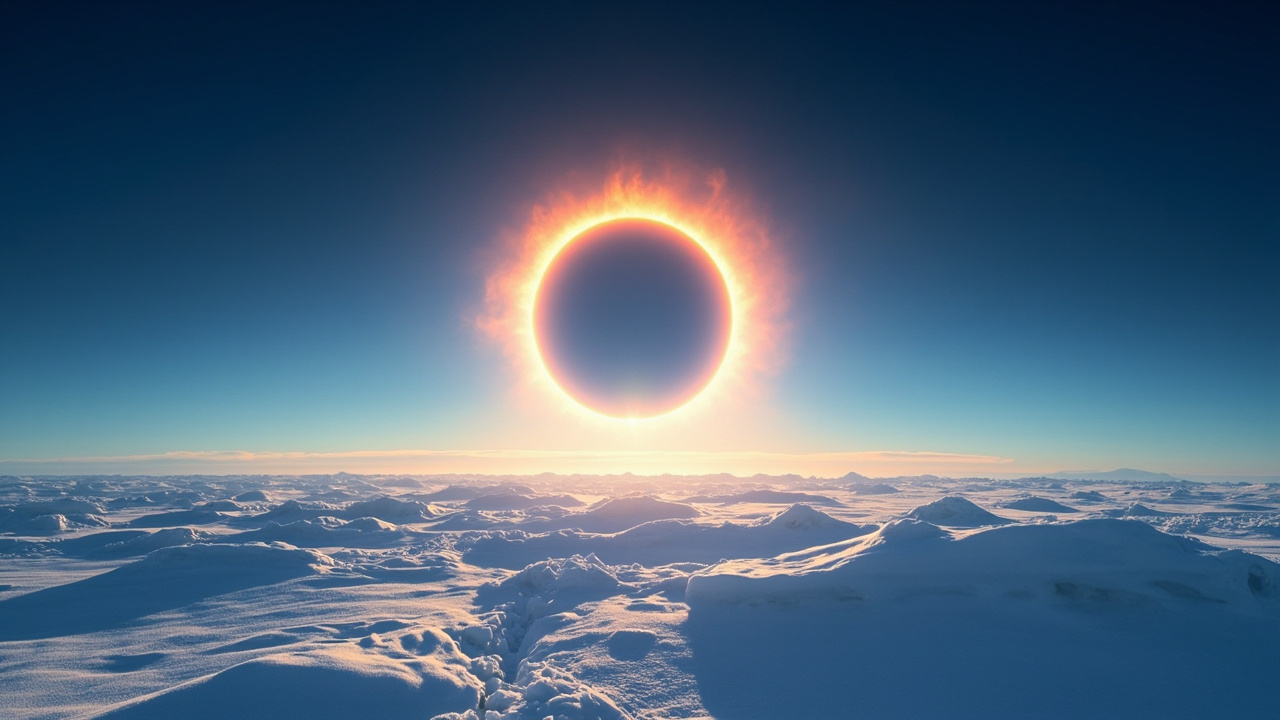
An annular solar eclipse occurred over Antarctica
On February 17, an annular solar eclipse created a "ring of fire" in the skies over Antarctica. The event was visible to a handful of researchers and a large population of penguins on the frozen continent.
The moon passed between Earth and the sun, covering about 96% of the sun's disk. This left a thin, bright outer ring of sunlight visible for up to 2 minutes and 20 seconds at the point of greatest eclipse.
The path was remote and narrow
The path of annularity was a corridor roughly 2,661 miles long and 383 miles wide. Only a very small, remote region of Antarctica fell within this path where the full "ring of fire" effect was visible.
Viewers elsewhere in Antarctica, along with parts of southern Africa and the southernmost tip of South America, saw only a partial solar eclipse. The spectacle was captured by satellites, which imaged the moon's shadow darkening the ice below.
How an annular eclipse works
An annular solar eclipse occurs when the moon is too far from Earth in its elliptical orbit to completely cover the sun. This results in the characteristic ring, or annulus, of sunlight around the moon's silhouette.
It is distinct from a total solar eclipse, where the moon appears large enough to completely block the sun's face, plunging the path into temporary darkness.
Viewing solar eclipses requires strict safety
It is never safe to look directly at the sun without proper protection. Observing any solar eclipse requires specialized solar filters to prevent serious eye injury.
- Viewers must wear certified solar eclipse glasses.
- Cameras, telescopes, and binoculars need solar filters placed over their lenses.
- The dangers are identical for both partial and annular eclipses.
Our guide on how to observe the sun safely details all necessary precautions for solar viewing.
More eclipses are on the horizon
The next major solar eclipse will be a total solar eclipse on August 12, 2026. Its path of totality will cross parts of Greenland, Iceland, and northern Spain.
A broader partial eclipse will be visible across Europe and Africa. Before that, a total lunar eclipse will occur on March 3, 2026, visible from North America, Australia, New Zealand, East Asia, and the Pacific.
Related Articles

ELT's 80-meter dome nears completion in Chile
A new photo shows the Extremely Large Telescope's dome nearing completion in Chile. The massive structure will house a giant mirror, with first light expected in 2029, revolutionizing our view of the cosmos.
Astronomers spot 4-million-light-year cosmic filament in Ursa Major
Astronomers used China's FAST telescope to discover a nearly straight line of galaxies spanning four light-years. This reveals a delicate filament of the cosmic web, dominated by dark matter, which acts as a hidden pathway guiding galaxy formation.
Stay in the loop
Get the best AI-curated news delivered to your inbox. No spam, unsubscribe anytime.