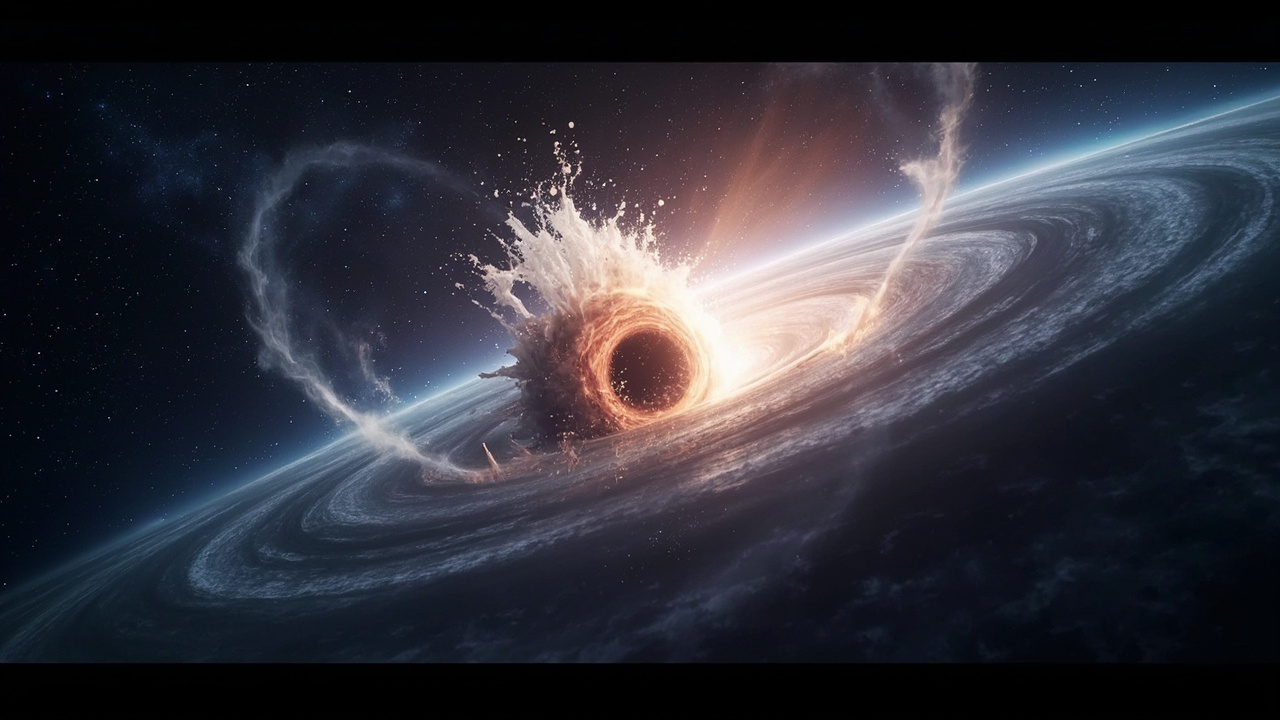
Einstein-Rosen bridge reinterpreted as quantum link between opposite time arrows
Summary
Einstein-Rosen bridges are not wormholes but a quantum link between two time directions, offering a solution to black hole information paradox and suggesting the Big Bang may have been a bounce from a prior universe.
The original Einstein-Rosen bridge was not a wormhole
New research argues the famous "Einstein-Rosen bridge" was never meant to describe a traversable wormhole. The work, published in The Conversation by astrophysicist Enrique Gaztañaga and colleagues, reinterprets the 1935 concept as a quantum link between opposite arrows of time.
Albert Einstein and Nathan Rosen introduced the bridge while studying particles in extreme gravity. Their goal was to reconcile gravity with quantum physics, not to propose a tunnel for space travel.
How wormholes became a pop culture staple
The wormhole interpretation emerged decades later through speculative physics. Analyses showed such structures would be unstable and impossible to traverse within Einstein's theory of general relativity.
There is no observational evidence for macroscopic wormholes. They remain a highly conjectural idea that flourished more in science fiction than in proven science.
A quantum mirror for time
The new research applies a modern quantum interpretation of time to the Einstein-Rosen bridge. It suggests the bridge connects two complementary components of a quantum state: one where time flows forward and one where it flows backward.
This framework is necessary for a complete quantum description near black holes or in bouncing universes. It naturally resolves the black hole information paradox, a major conflict between general relativity and quantum mechanics.
Stephen Hawking showed black holes evaporate, seemingly destroying information. The new model suggests information isn't lost but continues evolving along a mirrored, time-reversed direction.
Evidence in the cosmos and before the Big Bang
Evidence for this two-time structure may already exist. The cosmic microwave background shows a persistent spatial asymmetry that standard models struggle to explain unless mirror quantum components are included.
The theory leads to a profound cosmological possibility. What we call the Big Bang may have been a quantum bounce between two time-reversed cosmic phases, not an absolute beginning.
In this view, our universe could be the interior of a black hole that formed in a parent cosmos. Relics from the pre-bounce phase might even explain dark matter.
- The Einstein-Rosen bridge is a temporal link, not a spatial tunnel.
- It offers a quantum picture where spacetime balances opposite time directions.
- The Big Bang becomes a gateway, not a beginning.
No shortcuts, but a path to completion
This reinterpretation offers no science-fiction wormholes or time travel. Instead, it aims to complete Einstein's relativity and quantum physics by unifying them.
The next revolution in physics may reveal that time, at a fundamental level, flows both ways. It suggests our universe had a history before the Big Bang, all encoded in a misunderstood concept from 1935.
Related Articles
Astronomers spot 4-million-light-year cosmic filament in Ursa Major
Astronomers used China's FAST telescope to discover a nearly straight line of galaxies spanning four light-years. This reveals a delicate filament of the cosmic web, dominated by dark matter, which acts as a hidden pathway guiding galaxy formation.
Einstein's relativity explains scarcity of Tatooine-like planets
Fewer planets orbit binary stars than expected because Einstein's relativity can destabilize and eject them, explaining the scarcity of real "Tatooines."
Stay in the loop
Get the best AI-curated news delivered to your inbox. No spam, unsubscribe anytime.