
Einstein's relativity explains scarcity of Tatooine-like planets
Summary
Fewer planets orbit binary stars than expected because Einstein's relativity can destabilize and eject them, explaining the scarcity of real "Tatooines."
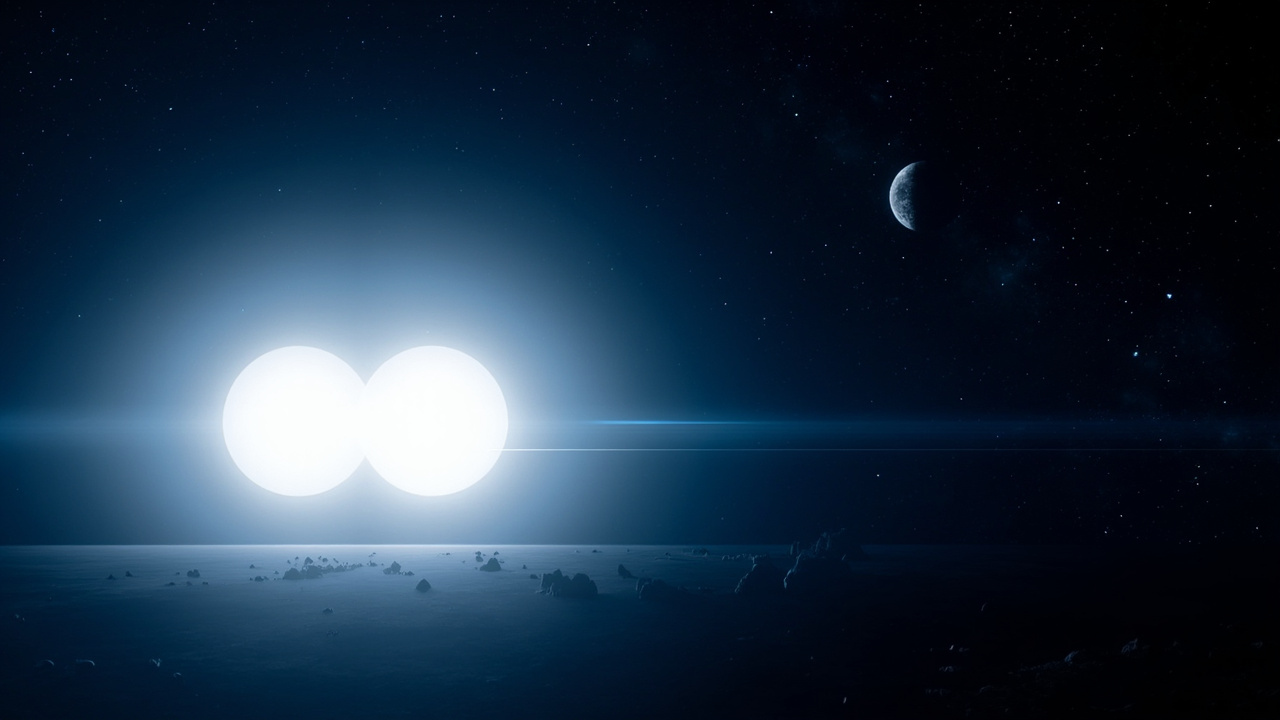
Einstein may explain the missing Tatooines
Planets orbiting two stars, like the fictional Tatooine from Star Wars, are far rarer than scientists predicted, and new research points to Albert Einstein's theory of general relativity as the culprit. While thousands of exoplanets have been confirmed, only 14 have been found around binary star systems, a tiny fraction of the expected number.
Researchers from the University of California, Berkeley, and the American University of Beirut published their findings in The Astrophysical Journal Letters on December 8, 2025. Their models show that the complex gravitational dance in these systems, governed by relativity, often ends with planets being destroyed or flung into space.
The gravitational dance that destroys planets
In a binary system, two stars orbit each other, and any planet caught in their gravity feels a pull from both. This causes the planet's orbital orientation to slowly rotate, or precess. The stars' own orbits also precess due to the effects of general relativity.
Over time, tidal forces can draw the stars closer together, which speeds up their precession. This, in turn, can slow the precession of an orbiting planet. When these two precession rates sync up, a resonance occurs that stretches the planet's orbit into an extreme ellipse.
"Either the planet swings too close to the stars and is torn apart, or its orbit is so perturbed that it's ejected from the system," said lead author Mohammad Farhat of UC Berkeley in a statement. This process makes stable, long-term orbits in tight binary systems exceptionally rare.
Why our search methods are biased
The research suggests this destructive resonance is most common in tight binary systems, where stars orbit each other in a week or less. These are precisely the systems most frequently monitored by planet-hunting missions like NASA's Kepler and TESS.
These telescopes use the transit method, detecting planets by the tiny dip in starlight that occurs when a planet passes in front of its star. The team's work implies that even if planets form in these tight binaries, general relativity may have already removed them by the time we look, creating an observational bias.
The key numbers highlight the discrepancy:
- Over 6,000 confirmed exoplanets exist in the Milky Way.
- About 10% of single-star systems are known to have planets.
- Scientists expected a similar rate for the 3,000 known binary systems.
- Only 14 circumbinary planets have been confirmed.
The search for more twin-sun worlds
The findings don't mean Tatooine-like planets don't exist. They may be more common in wider binary systems, where stars are farther apart and their gravitational interactions are less violent. These systems are harder for current transit methods to monitor effectively.
Ultimately, the research suggests there could be hundreds or thousands of such planets in the galaxy that have either been ejected or exist in systems we aren't surveying as closely. Future telescopes and detection methods may need to account for Einstein's disruptive influence to find them.
Related Articles
Earth's life-giving chemistry was a cosmic fluke, study finds
Life needs phosphorus and nitrogen. A study shows that during a planet's core formation, oxygen levels must be in a narrow "Goldilocks zone" to retain both elements. Earth had this luck; Mars did not. This changes how we search for habitable planets.
Annular solar eclipse creates 'ring of fire' over Antarctica
A "ring of fire" annular solar eclipse occurred over Antarctica on Feb. 17, visible as a partial eclipse in some southern regions.
Stay in the loop
Get the best AI-curated news delivered to your inbox. No spam, unsubscribe anytime.