
Genetic variant rs112233623-T reduces malaria severity by altering red blood cells
Summary
A genetic variant reduces CCND3 expression in red blood cells, increasing their size and decreasing their number. This impairs malaria parasite growth via reactive oxygen species, revealing a protective mechanism.
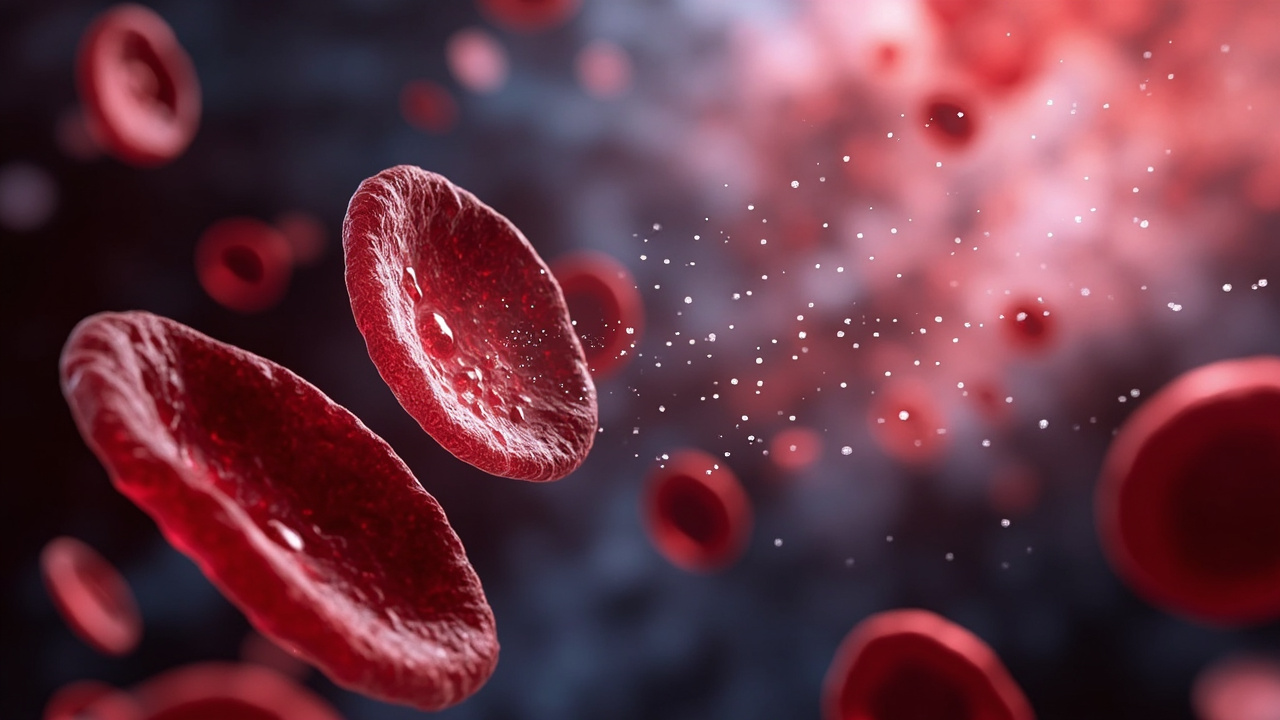
A genetic variant reduces malaria severity
A specific genetic variant that alters red blood cell development has been identified as a mechanism for resisting severe malaria. The research, published in Nature, shows the variant impairs the malaria parasite's ability to grow inside host cells.
The variant, known as rs112233623-T, is associated with larger, fewer red blood cells and higher levels of a hemoglobin subtype called hemoglobin A2. Scientists have now linked these physical traits directly to a protective effect against the Plasmodium falciparum parasite.
How the variant changes blood cells
The variant is located in an enhancer region for the gene CCND3, which produces cyclin D3. This protein is crucial for cell division in red blood cell precursors, known as erythroblasts.
Researchers found that rs112233623-T disrupts a binding site for the transcription factor SMAD3. This weakens the enhancer's activity, leading to reduced CCND3 expression.
The lower levels of cyclin D3 inhibit the G1–S cell-cycle transition in erythroblasts. This results in the production of fewer, but larger, mature red blood cells—exactly the traits observed in carriers of the variant.
Parasite growth is impaired in variant carriers
The study's key finding is that this altered red blood cell environment is hostile to the malaria parasite. In laboratory cultures, P. falciparum growth was impaired in red blood cells taken from people carrying the rs112233623-T variant.
The researchers connected this impaired growth to higher levels of reactive oxygen species (ROS). Cyclin D3 helps enhance the pentose phosphate pathway, a cellular process that counteracts ROS.
With reduced CCND3, this pathway is less effective, allowing ROS to accumulate. The data suggests this oxidative stress damages the parasite's ability to proliferate.
- Variant: rs112233623-T
- Gene Affected: CCND3 (cyclin D3)
- Key Physical Traits: Larger red blood cells, fewer red blood cells, higher hemoglobin A2
- Protective Mechanism: Increased reactive oxygen species (ROS) impair parasite growth
A shared pathway with another malaria resistance trait
The mechanism mirrors a known form of genetic malaria resistance: deficiency in the enzyme G6PD. This enzyme is also part of the pentose phosphate pathway that manages ROS.
G6PD deficiency is associated with protection against severe malaria in some populations. The study shows both traits—the CCND3 variant and G6PD deficiency—converge on a common ROS-based mechanism to hinder the parasite.
"This highlights a common ROS-based mechanism of malaria resistance," the authors state, connecting two seemingly different genetic adaptations.
Signs of evolutionary selection in Sardinia
Population genetic analysis revealed signatures of positive selection for the rs112233623-T variant in Sardinia. Malaria was historically endemic and a major cause of death on the Mediterranean island.
The finding suggests this variant was evolutionarily advantageous, providing a survival benefit in a malaria-prone environment. It was likely passed down through generations because it helped carriers survive infection.
Potential for new therapeutic interventions
The researchers propose that intentionally reducing CCND3 in erythroblasts could be a new therapeutic strategy for malaria. Mimicking the protective effect of the genetic variant might offer a novel way to combat the disease.
This approach would target the host's biology to create an environment resistant to the parasite, rather than targeting the parasite itself. It represents a promising new direction for drug development against a disease that causes hundreds of thousands of deaths annually.
Related Articles

First cat cancer genetic map shows mutations shared with humans
Cat cancer genetics study reveals similarities to human cancers, offering new treatment insights for both species.
AI maps gene control networks driving Alzheimer's disease
UCI researchers used a new machine learning tool, SIGNET, to create detailed maps of cause-and-effect gene interactions in Alzheimer's-affected brain cells, revealing key regulatory genes and pathways that drive the disease.
Stay in the loop
Get the best AI-curated news delivered to your inbox. No spam, unsubscribe anytime.