Magma surge triggered 28,000 earthquakes on Santorini in 2025
Summary
In 2025, tens of thousands of earthquakes near Santorini were caused by rising magma, which stalled 4 km under the seafloor, fracturing rock. AI and seafloor sensors provided detailed analysis.
Magma caused Santorini's 2025 earthquake swarm
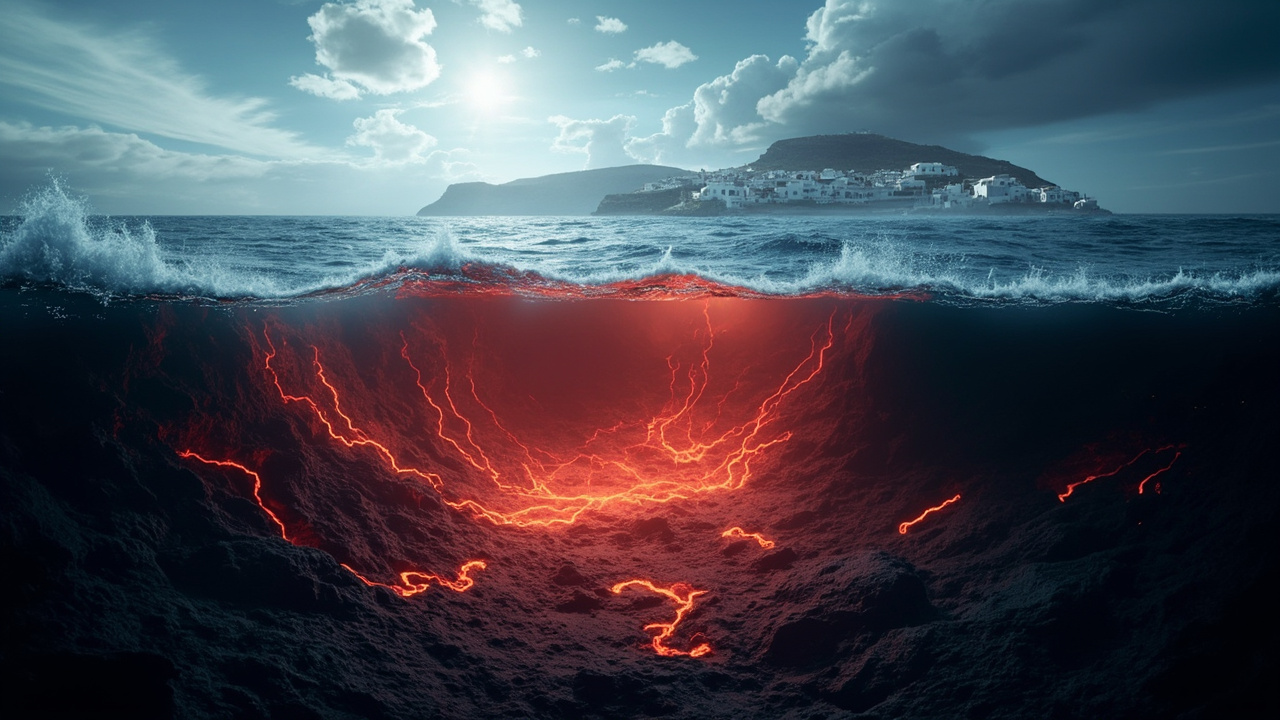
Scientists have determined that a massive intrusion of magma, not tectonic fault movement, caused the intense earthquake swarm that rattled the Greek island of Santorini in early 2025. A new study in Nature details how roughly 300 million cubic meters of molten rock rose from deep in the crust, fracturing rock and triggering more than 28,000 quakes.
Researchers from the GFZ Helmholtz Centre for Geosciences and GEOMAR Helmholtz Centre for Ocean Research Kiel led the investigation. They combined land-based seismic data with readings from ocean-floor instruments at the nearby Kolumbo submarine volcano.
How the magma moved underground
The process began months before the main seismic crisis. In July 2024, magma started accumulating in a shallow reservoir beneath Santorini, causing the island to uplift by a few centimeters.
Intense shaking started in late January 2025. The analysis shows magma then began rising again from deeper levels, with the earthquake cluster migrating more than 10 kilometers northeast of Santorini. The quakes' depths shifted upward in pulses, moving from about 18 kilometers deep to just 3 kilometers beneath the seafloor.
"The seismic activity was typical of magma ascending through the Earth's crust," said Dr. Marius Isken, a geophysicist at GFZ and lead author. "Our analysis enabled us to trace the path and dynamics of the magma ascent with a high degree of accuracy."
A hidden link between two volcanoes
As the magma shifted northeast, Santorini began to sink back down. The researchers say this subsidence is evidence of a previously unknown hydraulic connection between Santorini's magma system and the Kolumbo volcano, which lies just 7 kilometers away.
"We were able to follow the development of the seismic crisis in near real time and even learn something about the interaction between the two volcanoes," said Dr. Jens Karstens, a marine geophysicist at GEOMAR and co-lead author. He stated this will improve future monitoring of both volcanic systems.
The region is one of Europe's most geologically active. Key factors in its volatility include:
- Its location on the Hellenic volcanic arc.
- The collision of the African and Hellenic tectonic plates.
- A history of massive eruptions, including the caldera-forming event around 3,600 years ago.
AI and seafloor sensors provided a precise picture
Two technological advances were crucial for mapping the event in detail. First, GFZ scientists used a new AI-driven system to automatically analyze vast amounts of seismic data and pinpoint earthquake locations with high precision.
Second, GEOMAR had already deployed underwater monitoring platforms at Kolumbo's crater in early January as part of the MULTI-MAREX research project. These sensors recorded not only quakes but also pressure changes, showing the seabed sank by as much as 30 centimeters during the magma intrusion.
"The joint findings were always shared with the Greek authorities," said Prof. Dr. Heidrun Kopp of GEOMAR, project manager of MULTI-MAREX. This cooperation allowed for rapid assessment and public safety guidance during the crisis.
Ongoing monitoring in a volatile region
Although seismic activity has declined, monitoring continues. GFZ scientists are conducting repeated measurements of volcanic gases and temperatures on Santorini. GEOMAR currently operates eight seafloor monitoring platforms in the area.
The MULTI-MAREX project is part of a larger German research mission, mareXtreme, which aims to create a real-world laboratory to better understand marine hazards like earthquakes, eruptions, and tsunamis in the Mediterranean.
For the residents of Santorini, the findings clarify the cause of the alarming shakes but underscore the persistent volcanic threat in their iconic, unstable home.
Related Articles
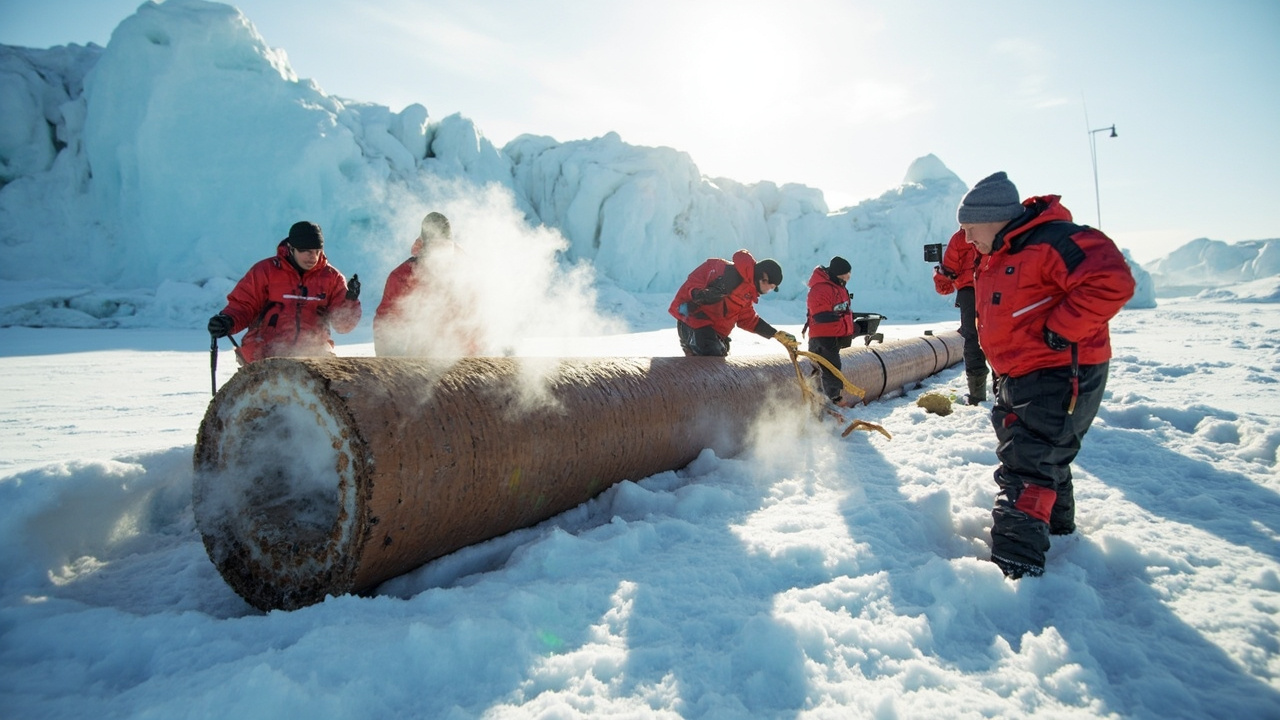
Scientists retrieve 228-meter rock core from Antarctic ice, spanning 23 million years
Scientists retrieved a 228-meter sediment core from under Antarctica's ice, revealing 23 million years of climate history to study past ice sheet retreat and future sea-level rise.

I Can Only Imagine' Holiday Sequel Streams on Great American Pure Flix
The film portrays devout but casual "bro Christianity," aiming for universal appeal like a Hallmark movie, not just a niche religious audience.
Stay in the loop
Get the best AI-curated news delivered to your inbox. No spam, unsubscribe anytime.