
Trump gives Iran 10 to 15 days to reach deal or face military strikes
Summary
Trump threatens Iran with military action if no deal is reached in 10-15 days, despite ongoing diplomatic talks.
Trump gives Iran 10 to 15 days to make a deal
President Donald Trump has issued a new ultimatum to Iran, suggesting the country has about 10 to 15 days to reach an agreement with the United States or face further military strikes. He made the threat during the inaugural Board of Peace meeting in Washington, DC, on Thursday.
Trump argued that last June's joint U.S.-Israeli strikes on Iran's nuclear facilities directly enabled the current Gaza ceasefire. He claimed the attack removed a regional "threat" that was blocking peace.
Diplomacy and military pressure proceed simultaneously
Trump's warning comes just days after U.S. and Iranian officials held a second round of indirect talks in Geneva. Iran's Foreign Minister, Abbas Araghchi, said Wednesday that the negotiations made "good progress" and established broad principles for a deal.
Despite the diplomatic talks, the U.S. military continues to build up forces in the Gulf region. This buildup includes two aircraft carrier strike groups and dozens of fighter jets.
The core disagreements remain stark. Iran has offered to curb uranium enrichment and accept rigorous inspections but denies seeking a nuclear weapon. The U.S. demands zero enrichment and limits on Iran's missile program, which Tehran calls non-negotiable.
Iranian leaders respond with defiance
Iranian officials have met Trump's threats with public defiance. Supreme Leader Ali Khamenei responded directly to the U.S. naval presence on social media Thursday.
"The Americans constantly say that they’ve sent a warship toward Iran. Of course, a warship is a dangerous piece of military hardware," Khamenei wrote. "However, more dangerous than that warship is the weapon that can send that warship to the bottom of the sea."
A cycle of threats and negotiations
Tensions have been high since late 2025. In December, Trump promised Israeli Prime Minister Benjamin Netanyahu he would strike Iran again if it rebuilt its nuclear or missile programs.
The situation has since cycled between confrontation and diplomacy:
- Antigovernment protests broke out in Iran days after Trump's December comments, with the President encouraging demonstrators.
- Trump appeared to de-escalate last month, claiming Iran halted dissident executions under U.S. pressure.
- The two sides resumed talks with a meeting in Oman on February 6, the first since the June war.
Trump's senior aides, Steve Witkoff and Jared Kushner, have led the negotiations. "We have to make a meaningful deal. Otherwise, bad things happen," Trump said Thursday.
The shadow of the abandoned nuclear deal
The current crisis unfolds under the long shadow of the 2015 nuclear agreement. Trump unilaterally withdrew the U.S. from that deal in 2018 during his first term, reimposing severe sanctions on Iran.
That agreement had required Iran to scale back its nuclear program in exchange for sanctions relief. Its collapse set the stage for the increased enrichment and hostilities that define the current standoff.
Related Articles
Brendan Fraser, Andrew Scott lead D-Day drama 'Pressure' on Apple TV+
A general and a meteorologist must decide whether to launch D-Day despite a dangerous storm, with the fate of WWII at stake.
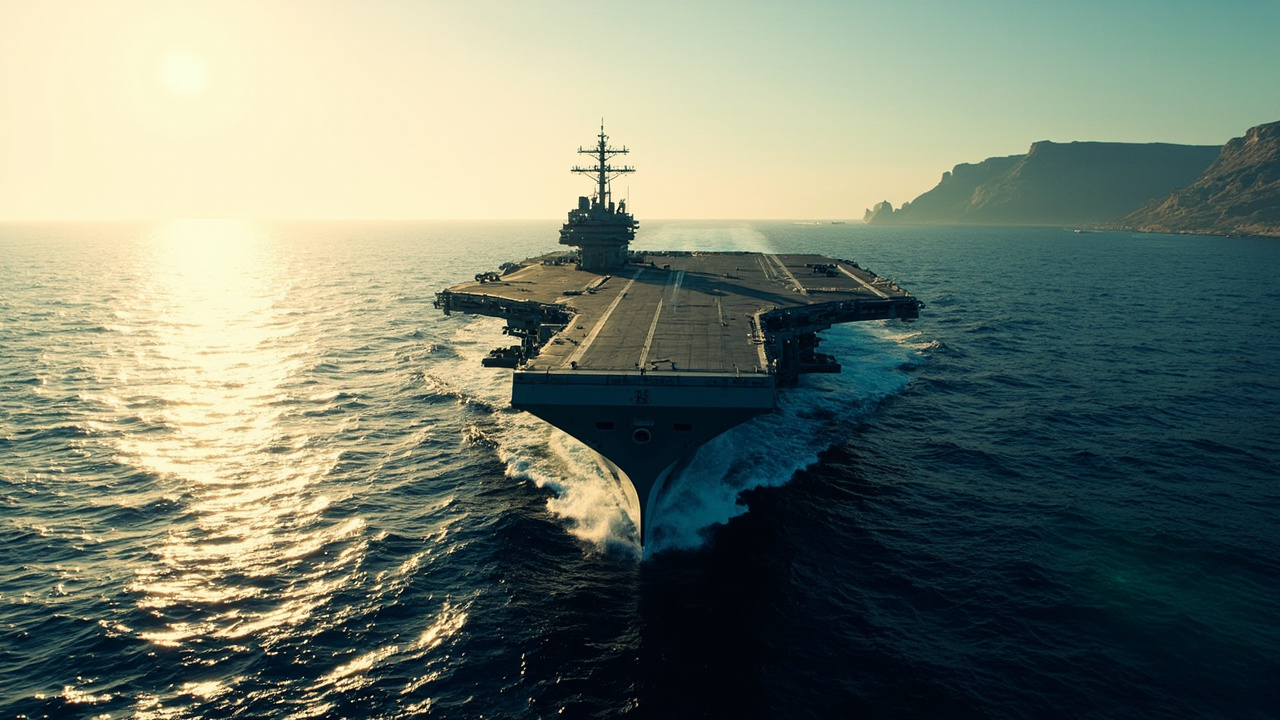
USS Gerald R. Ford to transit Strait of Gibraltar into Mediterranean
The world's largest nuclear aircraft carrier, the USS Gerald R. Ford, is preparing to transit the Strait of Gibraltar. It is heading to the eastern Mediterranean amid heightened Middle East tensions, as part of a major U.S. military reinforcement.
Stay in the loop
Get the best AI-curated news delivered to your inbox. No spam, unsubscribe anytime.