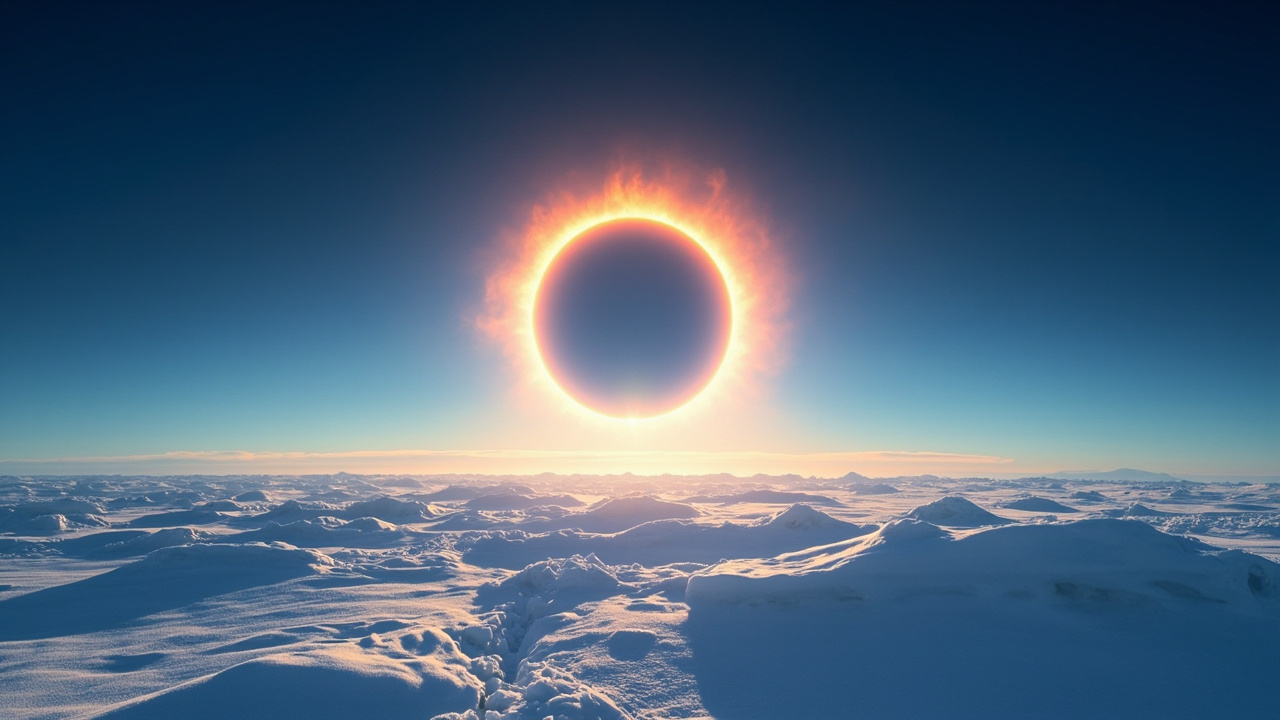
Annular solar eclipse creates 'ring of fire' over Antarctica
Summary
An annular solar eclipse occurred over Antarctica on Feb. 17, visible as a partial eclipse in parts of southern Africa and South America. The next major eclipse is a total solar eclipse on Aug. 12, 2026.

An annular solar eclipse occurred over Antarctica
An annular solar eclipse crossed a remote part of Antarctica on Saturday, February 17th. The event was primarily visible to more penguins than people, with only a partial eclipse seen from parts of southern Africa and South America.
The annular phase, when the moon covers the center of the sun to create a "ring of fire," occurred at 7:12 a.m. EST (1212 GMT). This type of eclipse happens when the moon is at a farther point in its elliptical orbit around Earth, making its disk appear too small to completely cover the sun.
How an annular eclipse works
During any solar eclipse, the moon passes between the sun and Earth, casting its shadow on our planet. The key difference between an annular and a total eclipse is the moon's distance from Earth.
In an annular eclipse, the moon is near its apogee—its farthest point from Earth. This means it doesn't fully block the sun's disk, leaving a bright ring of sunlight visible around the moon's silhouette. This creates the distinctive "ring of fire" effect.
- Annular Eclipse: Moon is farther away. Sun's outer edges remain visible as a ring.
- Total Eclipse: Moon is closer. Sun is completely obscured for a period called totality.
The next major eclipse is in 2026
The next solar eclipse with a significant human audience will be a total solar eclipse on August 12, 2026. It will be visible from Greenland, western Iceland, and northern Spain.
Observers in the path of totality will experience up to 2 minutes and 18 seconds of daytime darkness. This event will occur the day before the peak of the annual Perseid meteor shower, potentially creating a spectacular back-to-back celestial show.
Planning for the 2026 eclipse
For those already looking ahead, travel planning resources are available. Specific guides highlight the best locations and experiences for the 2026 event.
Recommended planning steps include:
- Reviewing lists of the best places to view the eclipse.
- Considering specialized eclipse cruise packages.
- Booking travel and accommodations well in advance, as prime locations fill quickly.
The 2026 eclipse offers a far more accessible viewing opportunity than the recent Antarctic event, promising a major astronomical spectacle for millions.
Related Articles
Annular solar eclipse creates 'ring of fire' over Antarctica
A "ring of fire" annular solar eclipse occurred over Antarctica on Feb. 17, visible as a partial eclipse in some southern regions.

Giant dome for world's largest telescope nears completion in Chile
A new photo shows the Extremely Large Telescope's dome nearing completion in Chile. The massive structure will house a giant mirror, with first light expected in 2029, revolutionizing our view of the cosmos.
Stay in the loop
Get the best AI-curated news delivered to your inbox. No spam, unsubscribe anytime.