
Psychedelics suppress vision, trigger hallucinations via memory, study finds
Summary
Psychedelics bind to serotonin receptors, reducing visual input. The brain compensates by pulling memories, causing hallucinations. This shift is driven by slower brain waves, which may help treat depression by restructuring negative thought patterns.
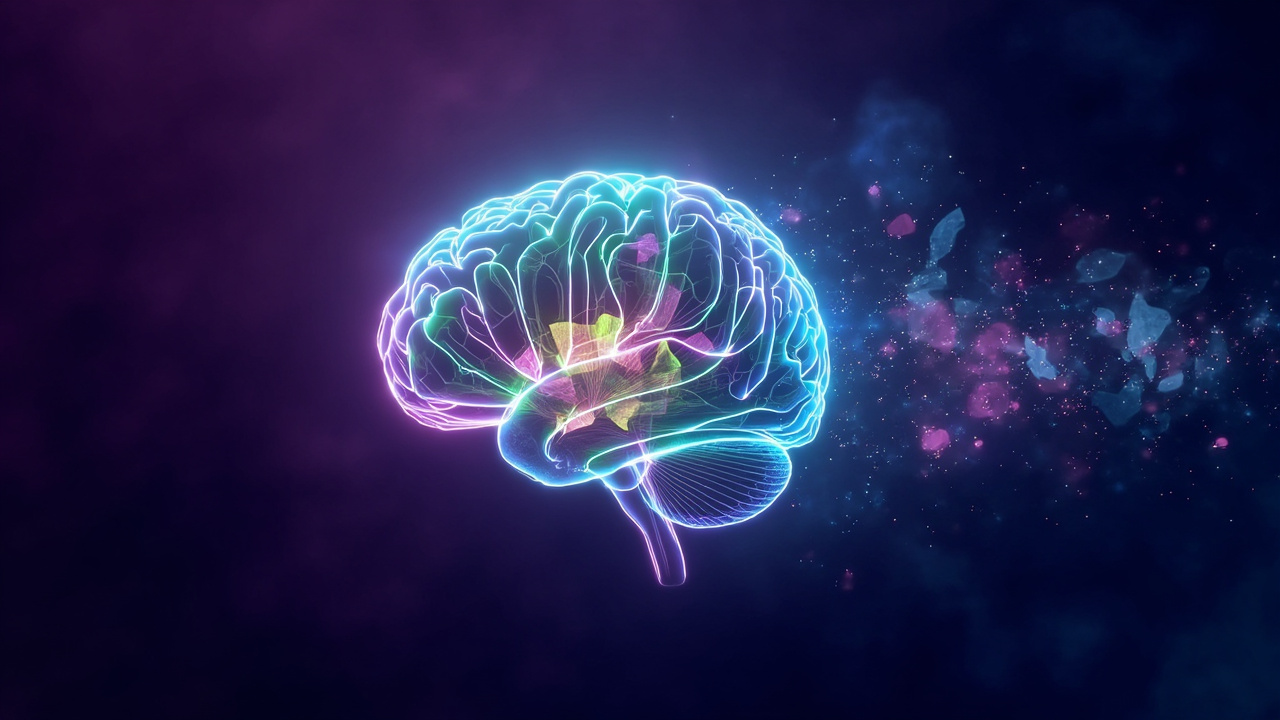
How psychedelics trigger hallucinations
Psychedelic drugs cause hallucinations by suppressing visual signals and forcing the brain to fill the gap with memories. This is the conclusion of new research from Ruhr University Bochum, which used real-time brain imaging in mice to track the process.
The study found that substances like psilocybin bind strongly to a specific serotonin receptor in the brain, the 5-HT2A receptor. This receptor dampens activity in areas that process visual information from the outside world.
"Visual information about things happening in the outside world becomes less accessible to our consciousness," said first author Callum White. "To fill this gap, our brain inserts fragments from memory—it hallucinates."
Slow brain waves shift perception
The researchers also identified the real-time mechanism behind this shift. They observed that psychedelics increase low-frequency, 5-Hz brain waves in visual regions.
These slow oscillations then stimulate the retrosplenial cortex, a key hub for accessing stored memories. As communication between these areas strengthens, perception relies more on recalled information than on current external events.
Lead researcher Professor Dirk Jancke describes the resulting state as "a bit like partial dreaming," where awareness of the present weakens.
Advanced imaging reveals the source
The team captured these changes using an advanced optical imaging technique that tracks neural activity across the entire brain surface in real time. They conducted their experiments on genetically engineered mice from Hong Kong Baptist University.
These mice were designed to produce fluorescent proteins in specific brain cells, allowing the scientists to pinpoint the exact source of the signals. "We know exactly... that the measured fluorescent signals originate from pyramidal cells of the cortical layers 2/3 and 5," Jancke said.
These pyramidal cells are critical because they mediate communication within and between different brain regions.
Implications for treating mental illness
The findings could help refine psychedelic-assisted therapies for conditions like depression and anxiety. Researchers theorize that, under medical supervision, these substances can temporarily shift brain activity to encourage positive recall and disrupt negative thought patterns.
"Such substances can temporarily change the state of the brain to selectively recall positive memory content and restructure learned, excessively negative thought patterns," Jancke explained. He added that it will be exciting to see how these therapies are personalized in the future.
By detailing how psychedelics redirect perception from external inputs to internal memory networks, the study provides a clearer biological basis for both their hallucinogenic effects and their therapeutic potential.
Related Articles
Lack of fiber harms older brains in just three days, study in rats finds
A new study in rats found that a lack of dietary fiber, common in refined diets, can quickly impair emotional memory in older brains, specifically affecting the amygdala. This suggests fiber is crucial for cognitive health in aging.
Second pregnancy reshapes brain differently than first, study finds
A second pregnancy uniquely changes a woman's brain, with both similar and distinct neural transformations compared to a first pregnancy.
Stay in the loop
Get the best AI-curated news delivered to your inbox. No spam, unsubscribe anytime.