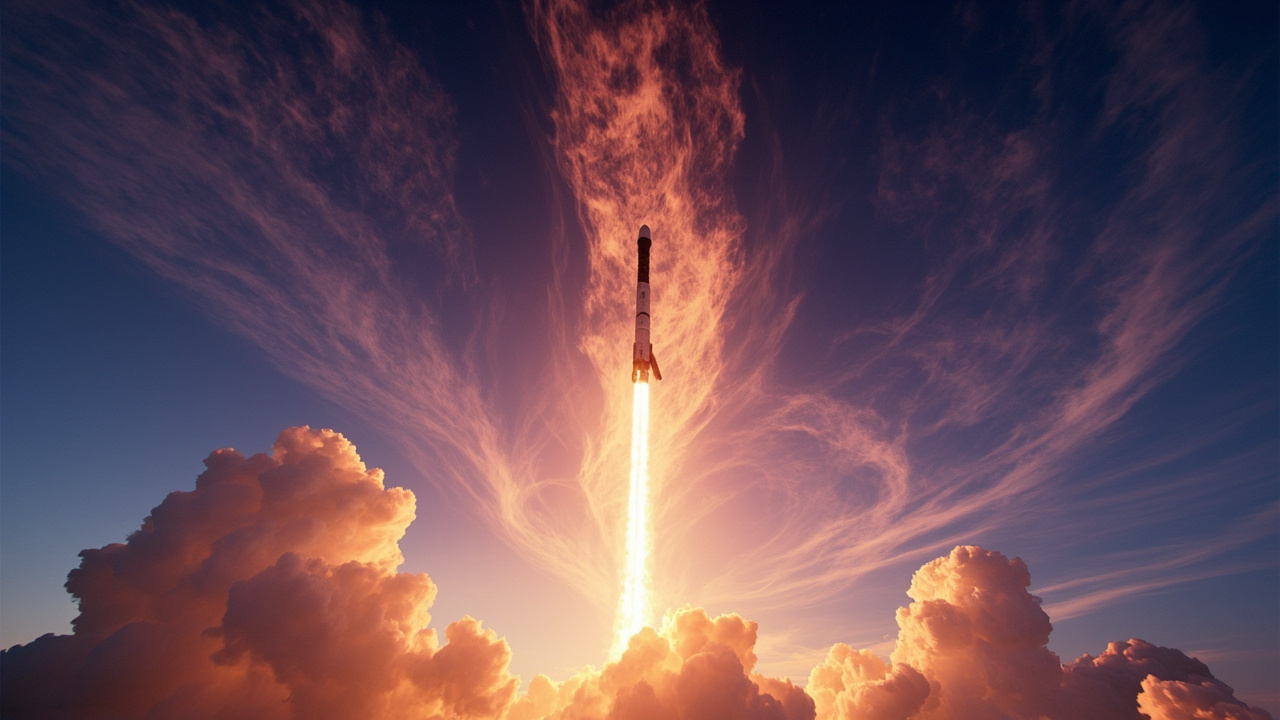
Scientists detect air pollution from SpaceX rocket reentry for first time
Summary
Scientists observed a lithium pollution plume from a SpaceX Falcon 9 rocket re-entering Earth's atmosphere in 2025, marking the first time space debris pollution was traced to a single event.
Scientists detect space junk pollution plume for the first time
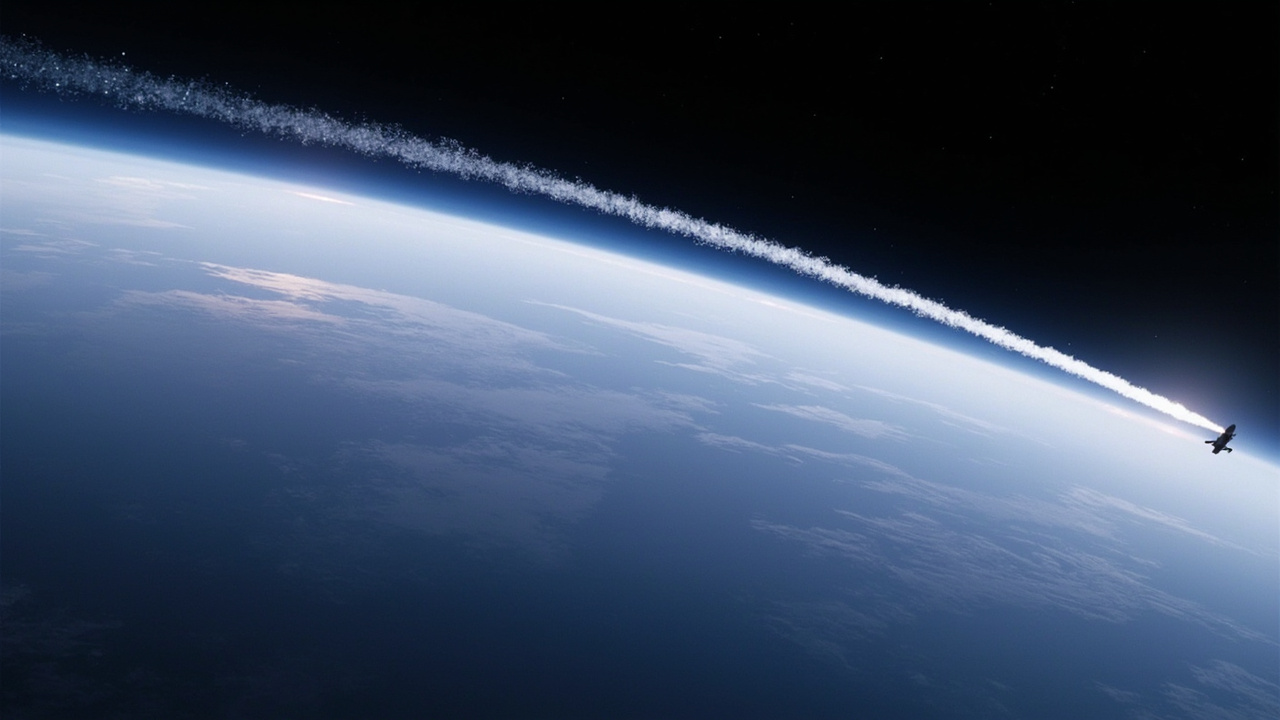
For the first time, scientists have directly observed a cloud of air pollution created by space debris burning up in Earth's atmosphere. The detection, made in February 2025, links a specific rocket re-entry to a measurable atmospheric plume.
The breakthrough was published in the journal Communications Earth & Environment on February 19, 2026. It provides a new method for tracking the environmental impact of the growing number of satellites and rockets returning to Earth.
A lithium signal from a SpaceX rocket
Researchers detected the pollution cloud on February 20, 2025, following the re-entry of a SpaceX Falcon 9 rocket upper stage over Europe. The team from the Leibniz Institute of Atmospheric Physics in Germany used a specialized LIDAR instrument to make the measurement.
They focused on detecting lithium, a metal present in rocket hulls and batteries. "We believe lithium to be a good tracer for [human-made] re-entry," said corresponding author Robin Wing. "There's very little lithium in natural meteorites."
The team estimated that a single Falcon 9 contains about 30 kilograms of lithium. In contrast, the total global daily input from natural meteorites is only about 80 grams.
Tracking the plume across Europe
The rocket stage vaporized at about 60 miles above the coast of Ireland. The resulting pollution plume then traveled on winds for roughly 20 hours before reaching Germany, where it was detected.
To confirm the plume's origin, scientists used a global atmospheric circulation model from the European Centre for Medium-Range Weather Forecasts. The model traced the plume back to the exact time and location of the Falcon 9's re-entry trajectory.
This successful tracking marks a significant observational milestone. "It's a bit of a breakthrough on both the observational and computational side," Wing said. "It's just never been done before."
Why space junk pollution is a growing concern
The volume of debris burning up in the atmosphere is increasing rapidly alongside the growth of satellite constellations. The European Space Agency estimates that more than three pieces of space junk re-enter Earth's atmosphere every day.
While natural meteorite material still dominates, scientists are concerned about the unique metals from spacecraft. Unlike natural space rock, this human-made debris releases chemicals that are not naturally abundant in the upper atmosphere.
The potential atmospheric impacts include:
- Ozone layer depletion from aluminum oxide particles
- Alteration of the atmosphere's thermal balance and reflectivity
- Unknown effects from other metals like lithium, copper, and titanium
The challenge of measuring aluminum
Most scientific debate has focused on aluminum, the most abundant metal in spacecraft bodies. When it burns up, aluminum reacts with oxygen to form aluminum oxide (alumina), a substance known to accelerate ozone depletion.
However, measuring aluminum directly is extremely difficult. "It reacts really quickly with oxygen, within a microsecond," Wing explained. "So the moment aluminum evaporates out of the rocket hull, the first atom of oxygen it finds, it bonds to."
This makes lithium an ideal tracer—it persists longer in the atmosphere, allowing scientists to track the pollution plume back to its source.
A new tool for atmospheric science
The research represents a critical step in understanding space industry impacts. "This study represents an important milestone in observing the influence of space sector activities on the atmosphere," said Professor Eloisa Marais, an atmospheric chemistry expert at University College London.
Since the initial detection, the Leibniz team has built a new LIDAR instrument capable of measuring multiple metal compounds simultaneously. This will allow them to better quantify what human-made material is entering the atmosphere.
"We will measure lithium, which is a tracer for space debris, sodium, which is a tracer for natural meteorites, and also scan for all the different elements that are present in spacecraft," said Wing. The goal is to provide data for more accurate atmospheric models that can predict the long-term environmental effects of rocket re-entries.
Related Articles
SpaceX launches 53 Starlink satellites from California and Florida in two days
SpaceX launched 53 Starlink satellites in two Falcon 9 missions over two days, successfully deploying them and landing the boosters.

Elon Musk directs xAI to plan moon factory with satellite catapult
Elon Musk wants a moon factory and electromagnetic catapult to launch AI satellites, an idea echoing 1970s proposals for lunar mass drivers to exploit space resources.
Stay in the loop
Get the best AI-curated news delivered to your inbox. No spam, unsubscribe anytime.