
Scientists trace origin of ultra-energetic 'Amaterasu' cosmic ray
Summary
Scientists found the Amaterasu particle, an ultra-energetic cosmic ray, likely came from a nearby star-forming galaxy, not an empty void.
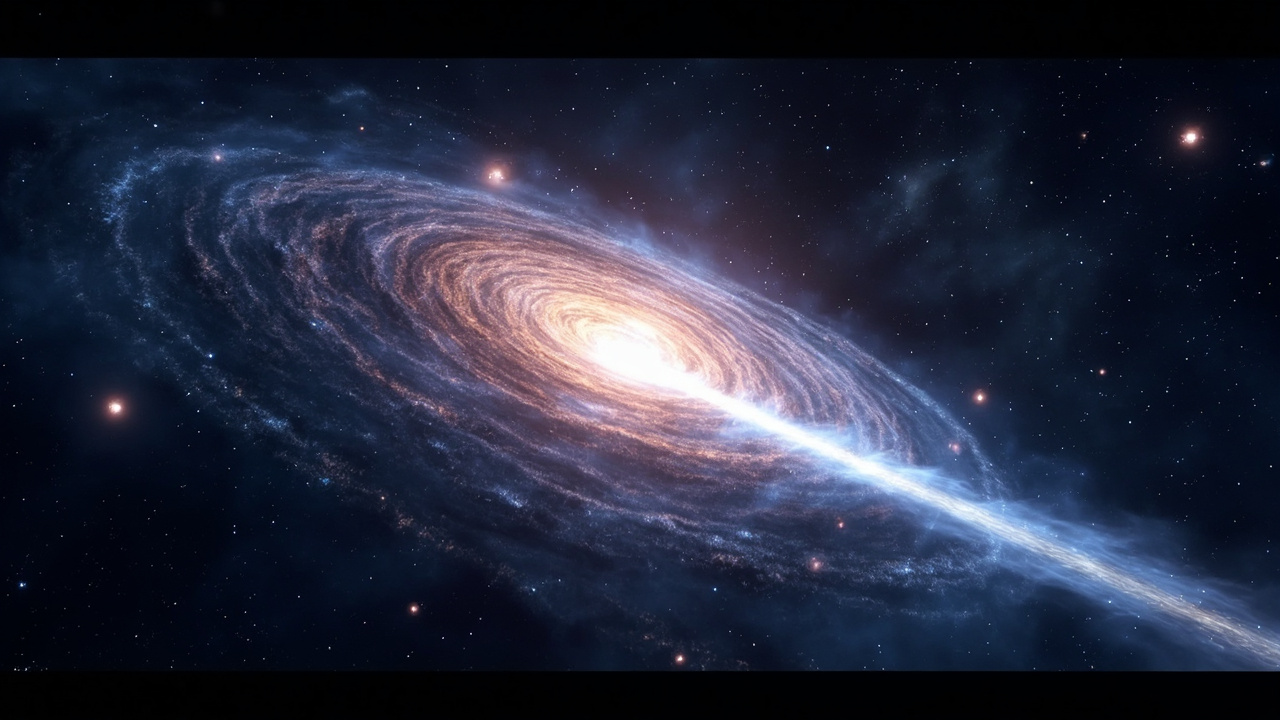
The Amaterasu particle’s mysterious origin
Scientists have traced the possible origin of one of the most energetic particles ever detected, a cosmic ray named Amaterasu that struck Earth in 2021. The particle carried 40 million times more energy than particles accelerated by the Large Hadron Collider.
It is the second most energetic cosmic ray ever recorded, after the "Oh-My-God" particle detected in 1991. The source of such ultra-high-energy cosmic rays has long been a major puzzle in astrophysics.
A particle from an empty void
Amaterasu’s detection deepened the mystery because its apparent arrival direction pointed to the "Local Void," a vast, empty region of space. This was perplexing because scientists believe these particles are forged in extreme environments, like the wreckage of supernova explosions or the cores of active galaxies.
A void, lacking such violent cosmic factories, seemed an unlikely birthplace. This contradiction prompted researchers Francesca Capel and Nadine Bourriche of the Max Planck Institute for Physics to investigate further.
Mapping a new probable path
The researchers used a novel, data-driven approach to model the particle’s journey. They applied a statistical technique called Approximate Bayesian Computation to simulate how Amaterasu’s path would have been bent by magnetic fields in three dimensions.
"This approach works by comparing the results of realistic, physics-based simulations with actual observational data to infer the most probable source locations," Bourriche said in a statement. The result was a series of probability maps pointing to possible origins.
The likely source is a nearby galaxy
The analysis suggests Amaterasu did not come from the empty Local Void. Instead, the maps point to a range of more plausible, nearby cosmic environments. The most likely candidate is a relatively local star-forming galaxy.
"Our results suggest that, rather than originating in a low-density region of space like the Local Void, the Amaterasu particle is more likely to have been produced in a nearby star-forming galaxy such as M82," Bourriche said. M82 is a well-known starburst galaxy about 12 million light-years away.
Implications for cosmic ray science
The findings, published on January 28 in The Astrophysical Journal, do more than solve one particle’s mystery. They provide a new method to help identify the powerful cosmic accelerators that produce these rare, ultra-high-energy particles.
"Exploring ultra-high-energy cosmic rays helps us to better understand how the Universe can accelerate matter to such energies," Capel said. The team aims to refine their statistical methods to exploit data more fully and pinpoint these extreme cosmic factories.
The key characteristics of the Amaterasu particle include:
- Detected in 2021 by the Telescope Array experiment.
- Energy is second only to the 1991 "Oh-My-God" particle.
- Its probable path was reconstructed using 3D magnetic field modeling.
- The new analysis points to origins in star-forming galaxies, not empty space.
Related Articles
NASA launches twin rockets to study aurora electrical currents
NASA launched two rockets from Alaska to study auroras, gathering data on black auroras and electric currents within the northern lights.
Astronomers find star shredded by intermediate-mass black hole
Astronomers observed a short, off-center optical flare from a star being ripped apart by a black hole. This event suggests the black hole is of the elusive intermediate-mass class, located in a dense star cluster far from its galaxy's core.
Hubble and Chandra hunt for rogue black holes in dwarf galaxies
Astronomers used Hubble and Chandra to hunt for wandering black holes in dwarf galaxies. Finding them could reveal a "fossil record" of early black hole seeds, helping explain how supermassive black holes grew so quickly in the early universe.
Stay in the loop
Get the best AI-curated news delivered to your inbox. No spam, unsubscribe anytime.