
Hubble and Chandra hunt for rogue black holes in dwarf galaxies
Summary
Astronomers used Hubble and Chandra to hunt for wandering black holes in dwarf galaxies. Finding them could reveal a "fossil record" of early black hole seeds, helping explain how supermassive black holes grew so quickly in the early universe.
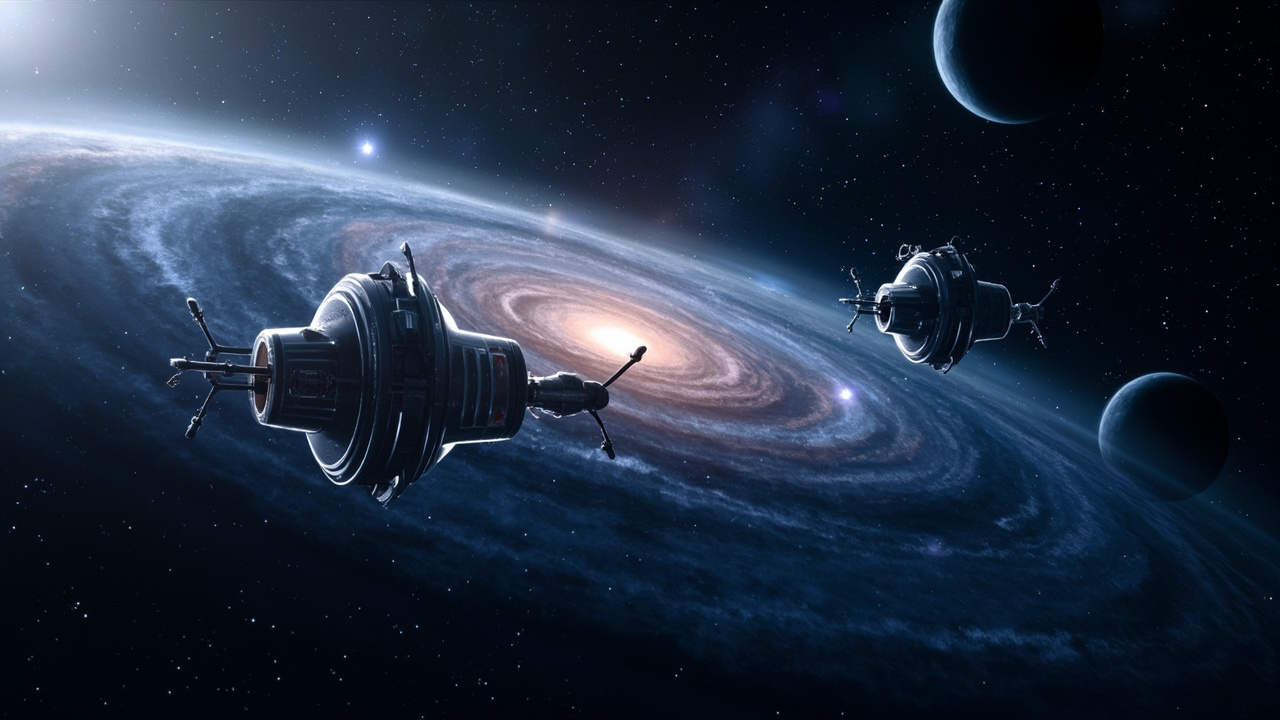
Astronomers hunt for wandering black holes in dwarf galaxies
Using NASA's Hubble Space Telescope and Chandra X-ray Observatory, astronomers have searched for "wandering" black holes drifting through dwarf galaxies. The discovery of these rogue black holes could provide a "fossil record" to explain how supermassive black holes grew so massive so early in the universe's history.
Supermassive black holes sit at the center of all large galaxies. The James Webb Space Telescope has found them already in place when the cosmos was less than 1 billion years old. This is a problem because the standard theories of growth through mergers and feeding should take longer than that.
The search for elusive black hole seeds
One leading explanation is that the process starts with "black hole seeds." These seeds, which give growth a head start, have remained elusive in the early universe. Models predict their signatures should be visible in local dwarf galaxies, which have quieter merger histories than massive galaxies.
"Compared to more massive galaxies, dwarf galaxies can have lower central stellar densities and more irregularly shaped potential wells," team leader Megan R. Sturm of Montana State University told Space.com. "As a result, if a black hole forms in the outer reaches of its host galaxy, it is unlikely to ever spiral down into the center."
Some researchers predict that roughly half of all black holes in dwarf galaxies could be wandering. This means surveys focusing on galactic centers could be missing a huge population.
Why wandering black holes are hard to find
Detecting these objects is difficult. The active galactic nuclei (AGNs) that signal a feeding black hole in a dwarf galaxy are dim. They can also be confused with other bright cosmic phenomena.
- They are fainter than AGNs in massive galaxies.
- Their light signatures can lack traditional, easy-to-spot features.
- They can be mistaken for intense star-forming regions or supernova explosions.
"Observing massive black holes in the dwarf regime can be a complicated process," Sturm said. "This makes them both harder to see and easier to confuse."
Eight promising candidates found in radio waves
The team used Chandra and Hubble to study 12 dwarf galaxies where AGNs had previously been detected in radio waves. In eight of these galaxies, the radio emission was offset from the galactic center, suggesting a wandering black hole.
"These are potentially 'wandering' black hole candidates," Sturm said. The offsets were significant, around one to two kiloparsecs (3,262 to 6,524 light-years), and sometimes placed the source outside the host galaxy entirely.
The goal was to confirm these radio sources by detecting them in optical light with Hubble or X-rays with Chandra, which would solidify their identity as AGNs.
One candidate debunked, seven mysteries remain
The observations confirmed one source, designated ID 64, in both optical and X-ray light. However, this revealed it was actually a much more distant AGN that only appeared aligned with the dwarf galaxy from Earth's perspective.
The other seven candidates were not significantly detected in optical or X-ray wavelengths. This leaves their true nature unknown. "It remains a possibility that these are wandering black holes," Sturm said. They could be isolated or within star clusters too faint for Hubble to see.
Alternatively, like ID 64, they could be distant background objects. Solving this mystery will likely require a more powerful observatory.
The case for turning to the James Webb Space Telescope
The team suggests the $10 billion James Webb Space Telescope could provide the answers. Its superior resolution and sensitivity might finally reveal the source of the mysterious radio emissions.
"Identifying the origin of the off-nuclear radio sources for the remaining seven wandering black hole candidates may be possible with the exquisite capabilities of the JWST," Sturm said. It could spot whether the emission comes from a disrupted star cluster within the galaxy or a distant background galaxy.
The team's results are published in The Astrophysical Journal.
Related Articles
Annular solar eclipse creates 'ring of fire' over Antarctica
A "ring of fire" annular solar eclipse occurred over Antarctica on Feb. 17, visible as a partial eclipse in some southern regions.
Scientists trace origin of ultra-energetic 'Amaterasu' cosmic ray
Scientists found the Amaterasu particle, an ultra-energetic cosmic ray, likely came from a nearby star-forming galaxy, not an empty void.
Stay in the loop
Get the best AI-curated news delivered to your inbox. No spam, unsubscribe anytime.