
ESO photo shows lasers creating artificial stars above Chile observatory
Summary
ESO released a stunning photo of the Milky Way over its Paranal Observatory, where lasers create artificial guide stars to correct atmospheric distortion for its Very Large Telescope.
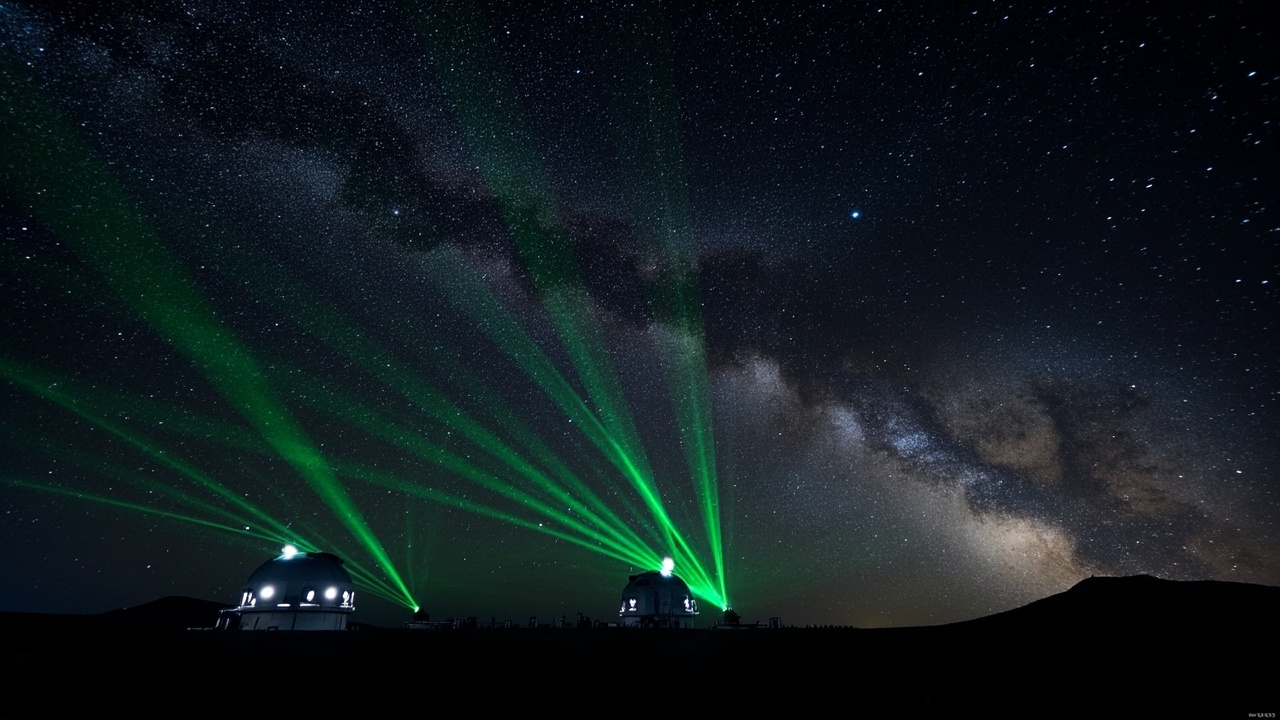
New photo captures Milky Way over observatory
The European Southern Observatory (ESO) has released a new photo showing the Milky Way galaxy arching over its Paranal Observatory in Chile. The image, captured by astrophotographer Alexis Trigo, also shows four powerful lasers creating artificial stars in the dark sky.
These lasers are a key part of the observatory's advanced adaptive optics systems. They help astronomers correct for the blurring effects of Earth's atmosphere in real time.
The Very Large Telescope in focus
The photo prominently features the four main telescopes of the Very Large Telescope (VLT). Each of these Unit Telescopes houses a primary mirror measuring 8.2 meters in diameter.
The telescopes are named Antu, Kueyen, Yepun, and Melipal. They can operate independently or together as a single, more powerful instrument.
- Antu
- Kueyen
- Yepun
- Melipal
A smaller, 1.8-meter auxiliary telescope is visible in the foreground. It can be moved on rails to support the light-gathering work of the larger telescopes.
How the laser guide stars work
The four orange beams firing from the telescope named Melipal are sodium lasers. They are projected 56 miles (90 kilometers) into Earth's upper atmosphere.
At that altitude, the lasers excite sodium atoms, causing them to glow and create artificial "guide stars." Astronomers use these precise points of light to measure atmospheric distortion.
This data is then fed to deformable mirrors on the VLT. The mirrors adjust their shape hundreds of times per second to cancel out the blurring, resulting in sharper images of space.
A major upgrade for sharper vision
The telescope Melipal has used its guide star laser system since 2016. In a significant upgrade, the other three Unit Telescopes received their own lasers in December 2025.
This expansion creates a constellation of artificial stars. It greatly enhances the capabilities of the VLT Interferometer and its GRAVITY+ instrument.
The upgrade allows the entire observatory to correct for atmospheric turbulence more effectively than ever before. This is crucial for studying fine details on exoplanets and observing the deep universe.
Related Articles

US seeks Greenland military sites for space race advantage
Trump's interest in Greenland centers on its strategic value for Arctic dominance and space operations, particularly the Pituffik Space Base, highlighting tensions in international space and territorial law.

Russian cosmonaut completes spacewalk outside International Space Station
A Russian cosmonaut conducted a spacewalk outside the International Space Station.
Stay in the loop
Get the best AI-curated news delivered to your inbox. No spam, unsubscribe anytime.