Thin crescent moon meets Saturn in western sky Feb. 19
Summary
On Feb. 19, look west at sunset to see a thin crescent moon near Saturn. You might also spot Mercury and Earthshine on the moon.
A thin crescent moon meets Saturn tonight
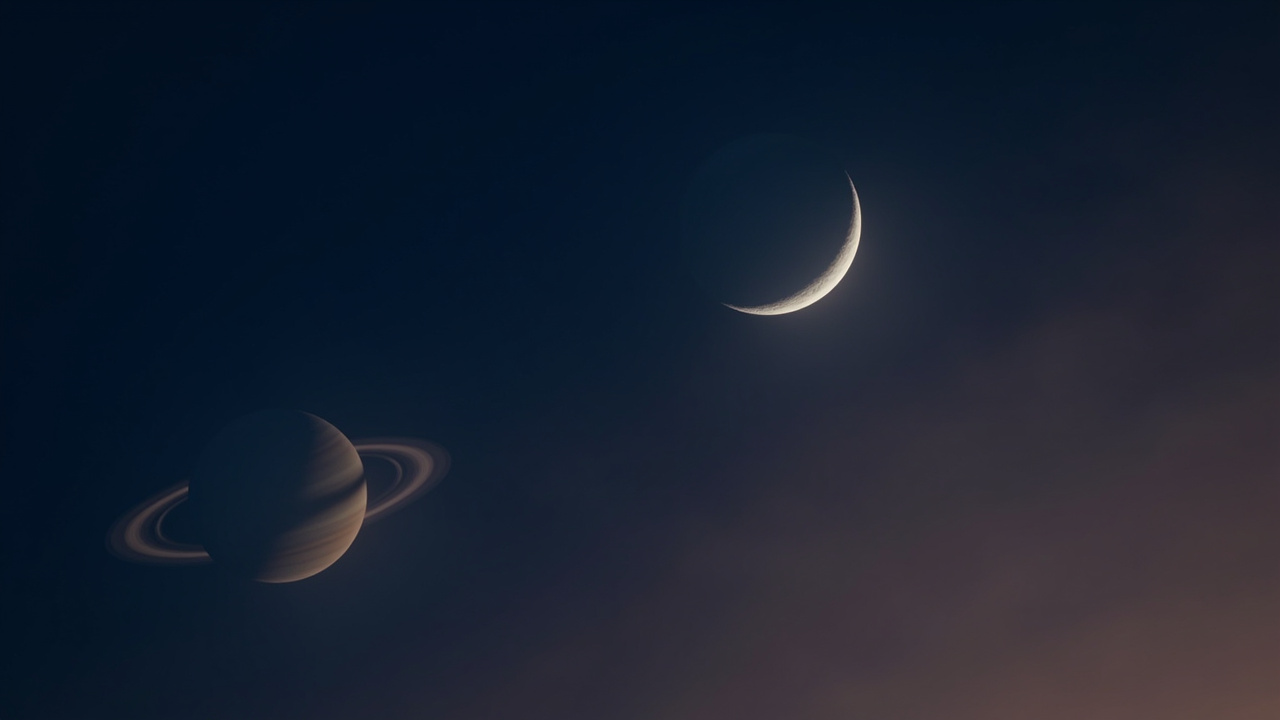
A two-day-old crescent moon will appear extremely close to the planet Saturn in the western sky after sunset on Wednesday, February 19.
The pairing will be a delicate sight, visible low on the horizon. The moon will be a 10%-lit waxing crescent, with Saturn shining as a bright point of light less than five degrees to its lower left.
How to spot the celestial duo
Look to the west shortly after the sun goes down. The moon and Saturn will be positioned low in the twilight sky.
They will set less than three hours after sunset for most observers in the United States. The exact timing for your location can be checked on sites like Time and Date.
- The moon will be a slender crescent.
- Saturn will appear as a steady, star-like point.
- They will be separated by roughly the width of your three middle fingers held at arm's length.
Watch for Earthshine and other planets
As darkness deepens, you may see a soft glow illuminating the moon's darkened portion. This is called Earthshine, or the "Da Vinci Glow," caused by sunlight reflecting off Earth's oceans and clouds onto the lunar surface.
Sharp-eyed observers with a clear western horizon might also spot Mercury shining to the lower right of Saturn. A fleeting glimpse of Venus is possible, but it will be very low and lost in the sun's glare quickly.
Neptune hides in plain sight
The distant planet Neptune will also be in the same region of sky, positioned less than two degrees to the right of Saturn.
However, it is far too faint to see without optical aid. Spotting its tiny blue disk will require a telescope with an aperture of at least 8 inches.
Gear up for future skywatching
This event is a naked-eye spectacle, but those interested in deeper exploration have options.
For viewing planets in detail, a good telescope is essential. For capturing events like this, a capable camera and lens are key tools for astrophotography.
Related Articles
US seeks Greenland military sites for space race advantage
Trump's interest in Greenland centers on its strategic value for Arctic dominance and space operations, particularly the Pituffik Space Base, highlighting tensions in international space and territorial law.
Russian cosmonaut completes spacewalk outside International Space Station
A Russian cosmonaut conducted a spacewalk outside the International Space Station.
Stay in the loop
Get the best AI-curated news delivered to your inbox. No spam, unsubscribe anytime.