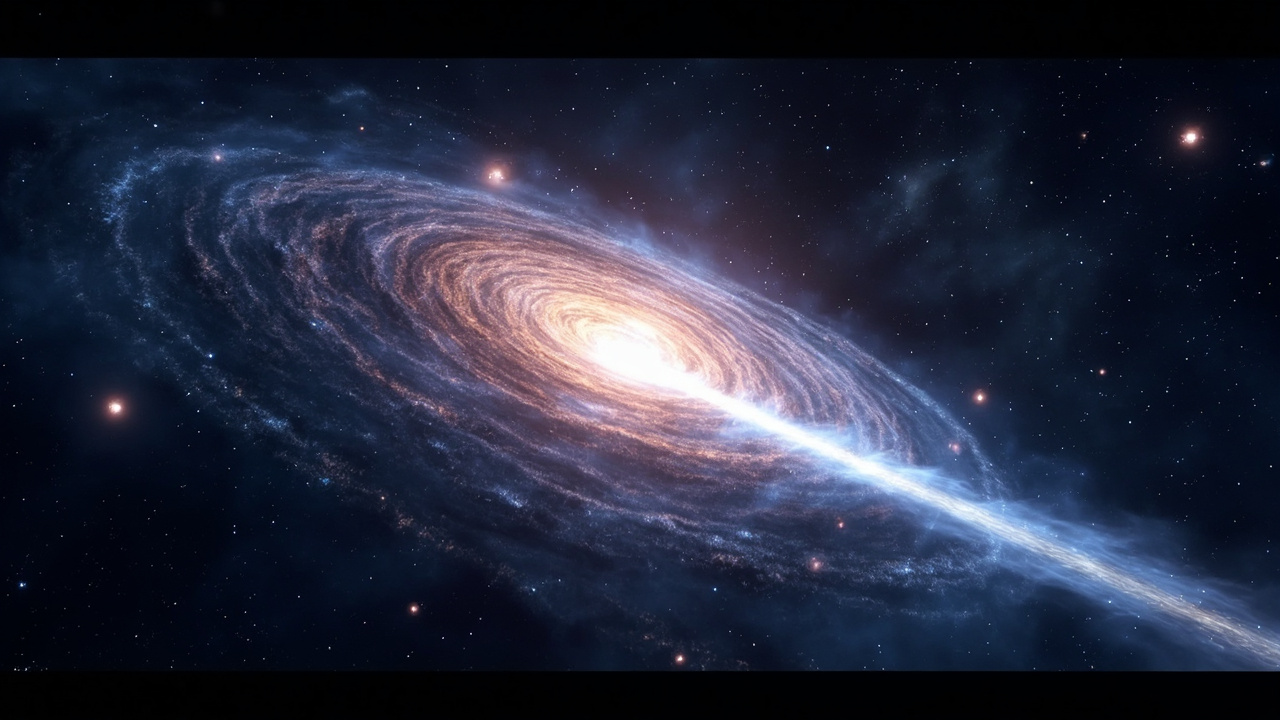
Scientists find millisecond pulsar near Milky Way's black hole
Summary
Scientists found a fast-spinning pulsar near our galaxy's central black hole. If confirmed, its precise pulses could test Einstein's gravity theory under extreme conditions.

Scientists find a promising pulsar near our galaxy's black hole
Scientists with the Breakthrough Listen initiative have identified a promising new millisecond pulsar candidate near the supermassive black hole at the center of our galaxy. The discovery, led by recent Columbia University PhD graduate Karen I. Perez, was made as part of the Breakthrough Listen Galactic Center Survey.
The findings were published in The Astrophysical Journal. The survey is one of the most sensitive radio investigations ever conducted to search for pulsars in the Milky Way's turbulent central region.
A cosmic clock for testing Einstein
If confirmed, the pulsar could become a unique tool for testing Einstein's theory of General Relativity under extreme conditions. Tracking its pulses would allow for highly accurate measurements of space-time around a supermassive black hole.
Pulsars are dense neutron stars that spin rapidly, emitting focused beams of radio waves like a lighthouse. Their pulses arrive on Earth with remarkable consistency, making them function as precise cosmic clocks.
- Millisecond pulsars spin especially fast, making their timing even more stable.
- This candidate is an 8.19-millisecond pulsar located close to Sagittarius A*.
- Sagittarius A* is the galaxy's central black hole, containing about 4 million times the mass of the Sun.
How gravity distorts the signal
"Any external influence on a pulsar, such as the gravitational pull of a massive object, would introduce anomalies in this steady arrival of pulses," said study co-author Slavko Bogdanov of the Columbia Astrophysics Laboratory. These anomalies can be measured and modeled.
As the pulses travel near the massive black hole, they may be deflected and experience time delays due to the warping of space-time. This effect is a key prediction of General Relativity that scientists hope to observe.
Next steps and public data
Researchers are now analyzing follow-up observations to determine if the candidate is a genuine pulsar. Because of its potential scientific significance, the broader astronomy community is being enlisted to help.
Breakthrough Listen is making the data publicly available to encourage independent analysis by teams worldwide. "We're looking forward to what follow-up observations might reveal," Perez said.
If confirmed, this object could provide new insights into our galaxy's core and the fundamental laws of gravity. The public data release aims to accelerate that confirmation process and related discoveries.
Related Articles

NASA launches twin rockets to study aurora electrical currents
NASA launched two rockets from Alaska to study auroras, gathering data on black auroras and electric currents within the northern lights.

Annular solar eclipse creates 'ring of fire' over Antarctica
A "ring of fire" annular solar eclipse occurred over Antarctica on Feb. 17, visible as a partial eclipse in some southern regions.
Stay in the loop
Get the best AI-curated news delivered to your inbox. No spam, unsubscribe anytime.