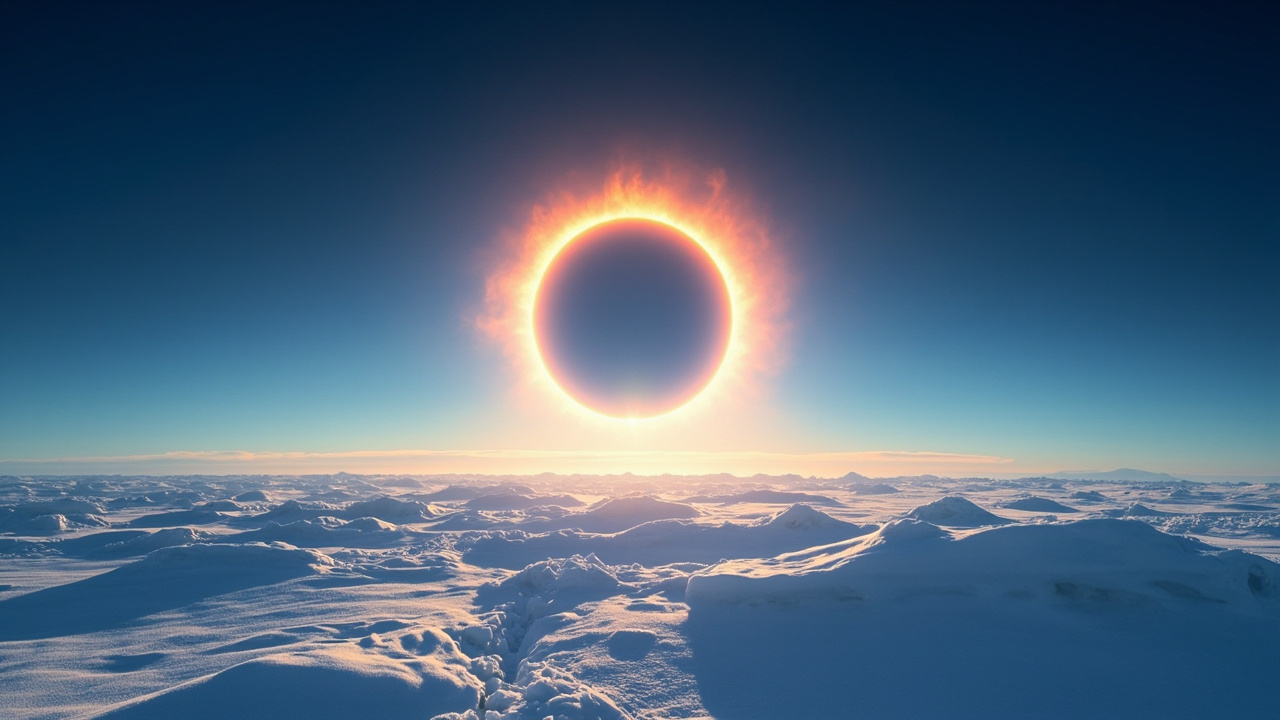
Annular solar eclipse creates 'ring of fire' over Antarctica
A "ring of fire" annular solar eclipse occurred over Antarctica on Feb. 17, visible as a partial eclipse in some southern regions.

AI-generated discussions on the latest tech and AI news. Every article gets a unique podcast episode.
863
Episodes
13+
Hours of content
A "ring of fire" annular solar eclipse occurred over Antarctica on Feb. 17, visible as a partial eclipse in some southern regions.

A new photo shows the Extremely Large Telescope's dome nearing completion in Chile. The massive structure will house a giant mirror, with first light expected in 2029, revolutionizing our view of the cosmos.
Astronomers used China's FAST telescope to discover a nearly straight line of galaxies spanning four light-years. This reveals a delicate filament of the cosmic web, dominated by dark matter, which acts as a hidden pathway guiding galaxy formation.

Comet Wierzchos makes its closest pass to Earth on Feb. 17, but it's too dim for the naked eye and low in the sky for many viewers.

Astronomers found methanimine, an organic molecule, in a cold gas cloud that will form a star and planets. This suggests future planets may start with life's basic ingredients.

Fewer planets orbit binary stars than expected because Einstein's relativity can destabilize and eject them, explaining the scarcity of real "Tatooines."

An annular solar eclipse occurred over Antarctica on Feb. 17, visible as a partial eclipse in parts of southern Africa and South America. The next major eclipse is a total solar eclipse on Aug. 12, 2026.

A 2026 annular solar eclipse created a "ring of fire" in the sky over Antarctica, visible to only a handful of people.
ESO released a stunning photo of the Milky Way over its Paranal Observatory, where lasers create artificial guide stars to correct atmospheric distortion for its Very Large Telescope.

New moon offers dark skies to spot Mercury, Saturn, constellations like Orion, and the Big Dipper.